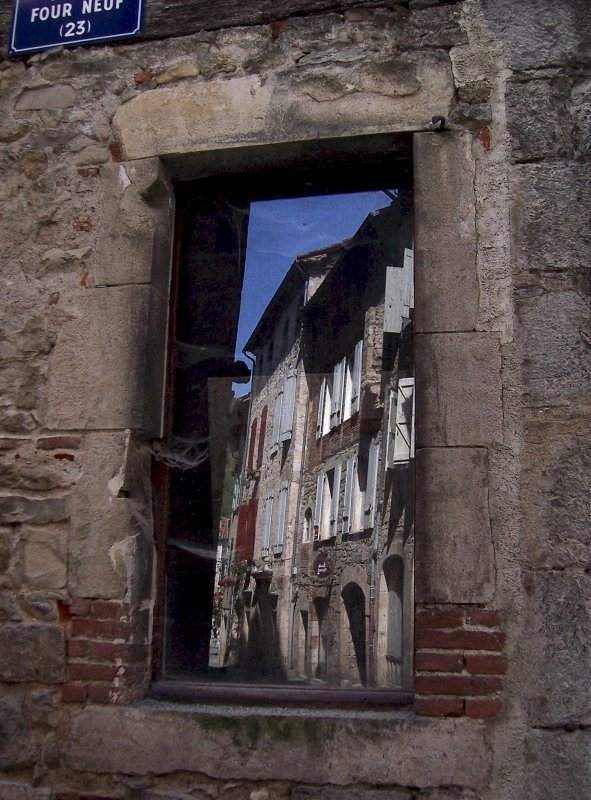
Maison des Consuls
Although this is a secular
building - the oldest such in France - the carvings on it (except for
one) follow two standard 12th century Romanesque themes: sin and the
punishment of sin.
Redemption does not feature - since Justice does not concern itself
with redemption.
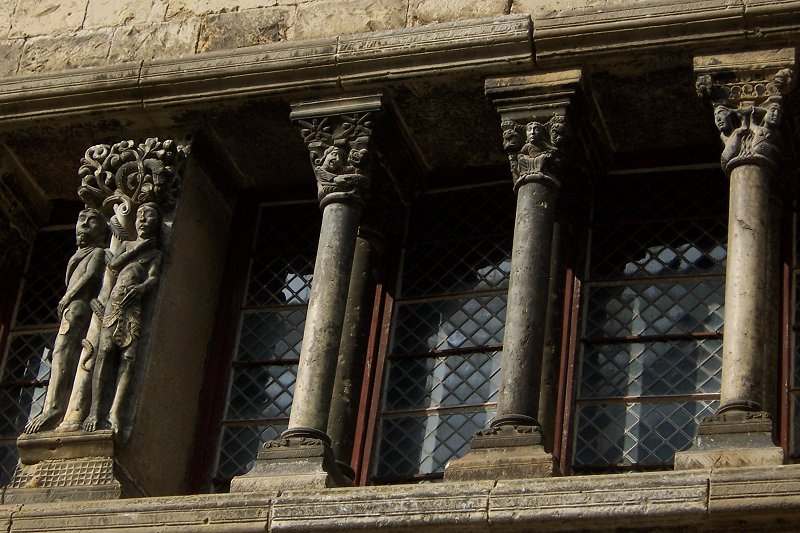
On the
left of the picture are Adam and Eve (close-up view on previous
page), symbolising the commission of sin.
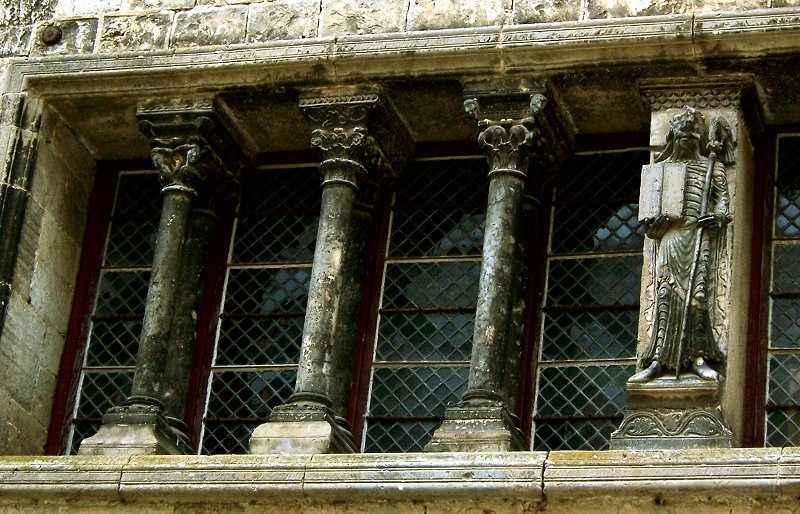
On the
right of the picture above is the Emperor Justinian as law-giver, bearing
a staff surmounted by the Imperial Eagle and holding an inscription
which reads:
IMPERATORIAM MAIESTATEM NON SOLUM ARMIS DECORATAM SED
ETIAM EGIBUS OPORTET ESSE ARMATAM VT VTRVMQVE - It is meet
that his Imperial Majesty should be empowered not just by force of arms
but also by the power of Justice. This inscription underlies the
purpose of the edifice for civil and not religious use.
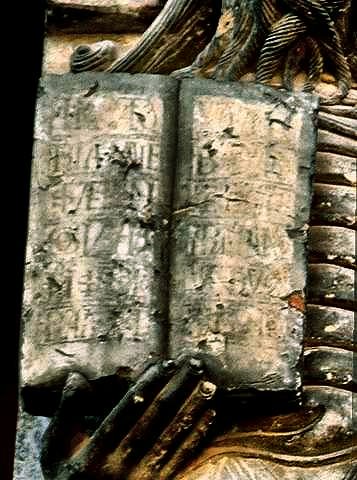
detail of Justinian's book, photographed
by Jacques Martin
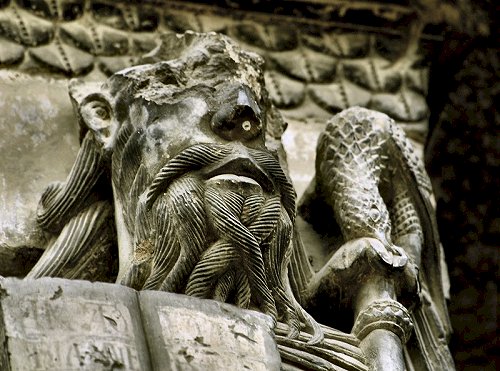
However, the capitals along the façade are very similar to those
illustrating sins on churches.
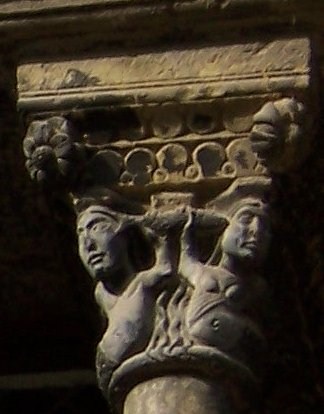
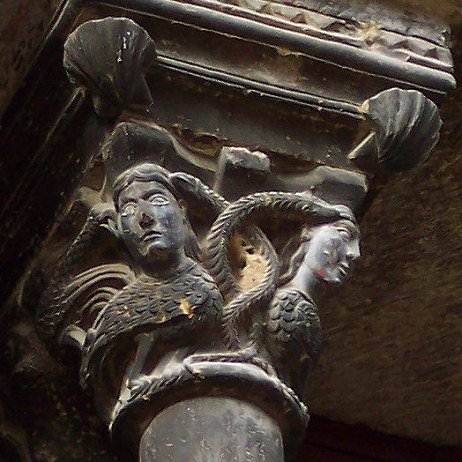
The
capital on the extreme left shows mermaids, symbols of Luxury, Vanity
and Self-indulgence.
The same theme appears on the capital on the extreme right of the window,
though the two creatures in this instance are brandishing a fish,
which may be the timeless phallic symbol or the ICHTHEUS
symbol of redemption - or both.
The letters in the Greek word for fish (ichtheus) are a Greek acronym
for Jesus Christ,
Son of God, Saviour, which ties in with the Fishers of Men phrase
in the Gospels.
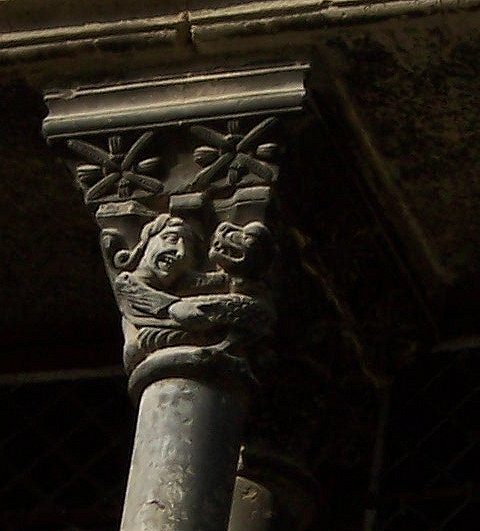
Other capitals show a sinful woman in the clutches of a monster - though
in the context of the Maison des Consuls it might be Justice
triumphing over Injustice;
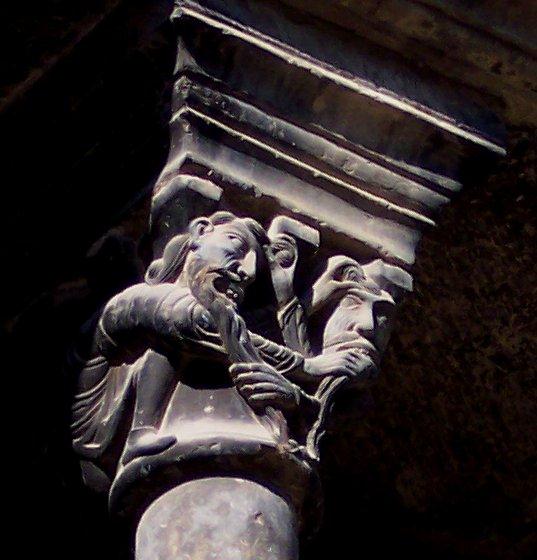
a pair of mutual beard-pullers
(symbol of strife);
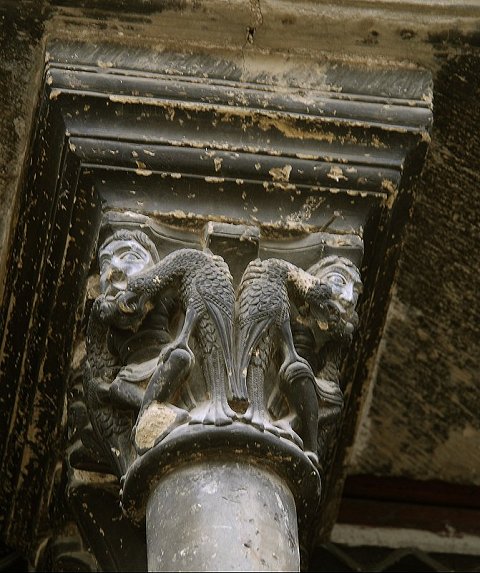
moustachioed
men being punished by eagles (symbols of divine retribution);
and more sinful women - this time their tresses (or artifical
hairpieces bought from nuns and the poor) being seized in the beaks
of long-necked eagles (symbol of righteousness and power).
These carvings are of
a high standard, especially that of Justinian (who resembles similar
sculptures of prophets at Moissac in the south of the same département,
and at Souillac (Lot).
If - as
seems very likely - the prestigious abbey, destroyed in the 16th century
by Protestants during the wars of religion, had carvings of similar
quality (and the exhibitionist corbel discussed on the previous page
would support this assumption), it must have been a treasure-house of
sculpture to match Moissac, one of the jewels of the Pilgrim
Roads.
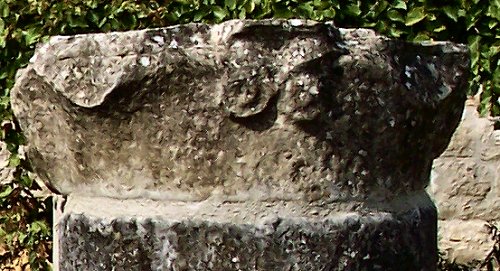
more vestiges of the
old abbey >
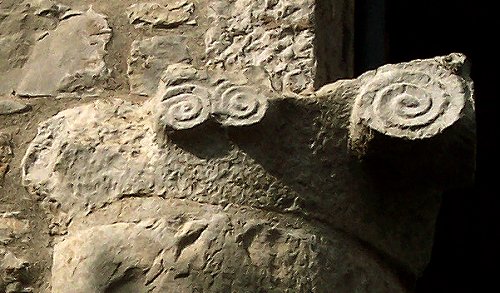
Another interesting Romanesque
fragment is close to the Maison des Consuls, at the corner of the rue
Valat and the rue Guilhem Peyré. A monster (representing Satan
or Hell) holds one end of a dead branch, while the other end is nibbled
by a hare (symbol of licentiousness and concupiscence).
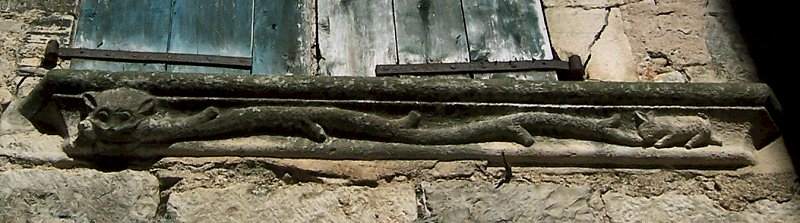
Thus the Tree
of Life (or the possibility of everlasting life for each of us)
is destroyed by the sins of the flesh.
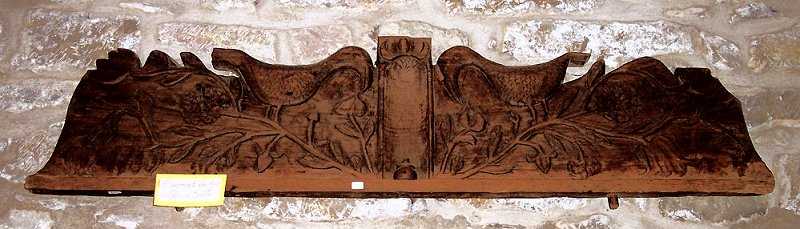
In the little (sadly-underfunded) museum
lodged in the Maison des Consuls on the Place de la Halle is
a rare Romanesque wooden panel depicting birds (representing the Holy
Spirit) amongst foliage (which often symbolises evil).
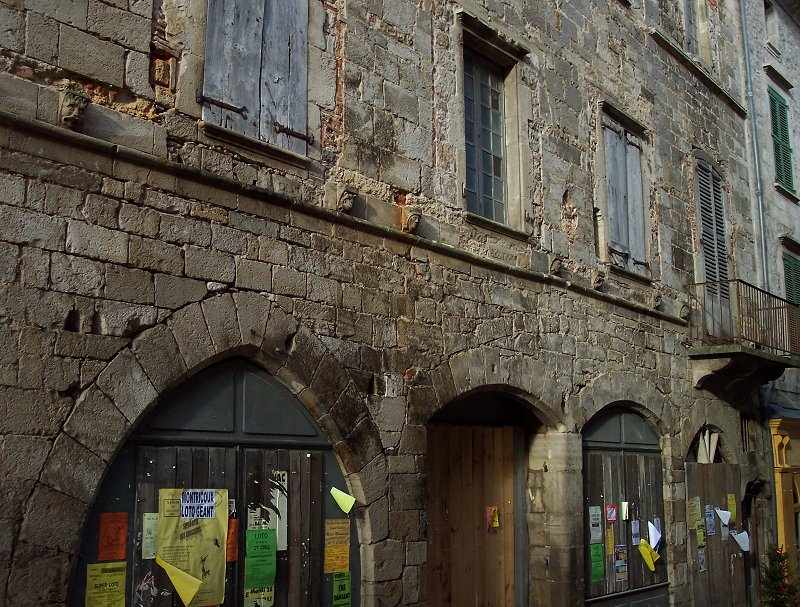
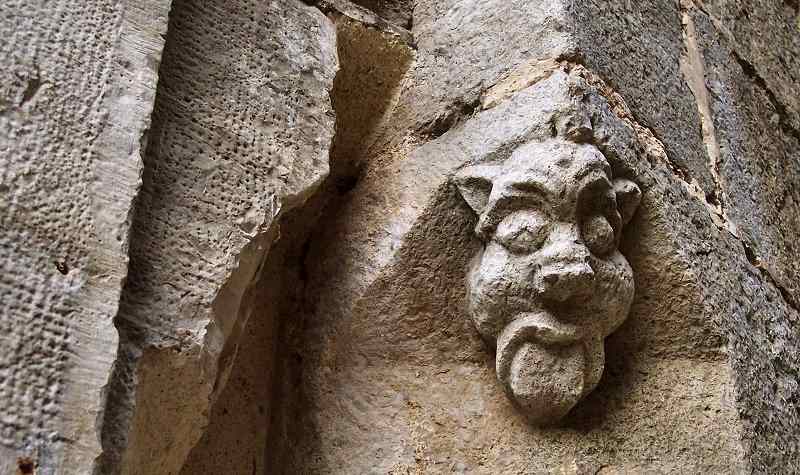
Also on the Place de la
Halle (number 33) is a series of corbels, mostly of Romanesque inspiration,
if not of 12th century date, two of which (photographed by Jacques
Martin) are pictured below.
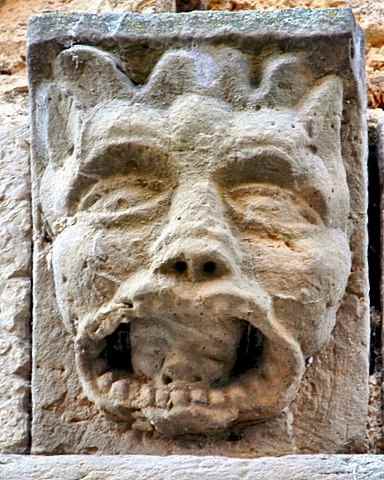

The façade of No.33, place de la Halle...
...and a little bracket corbel of a tongue-sticking beast or demon to
the left of the arcade.
These
carvings suggest that there was a wealth of Romanesque corbels on the
destroyed abbey of Saint-Antonin - rivalling those of Mauriac or Aulnay-de-Saintonge
or even Cervatos in Northern Castile - from which later sculptors drew
their inspiration, or which they simply copied.
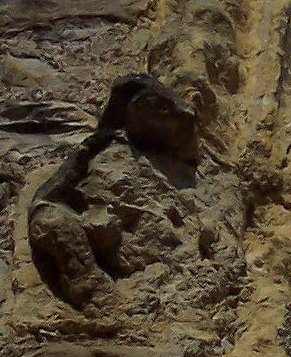
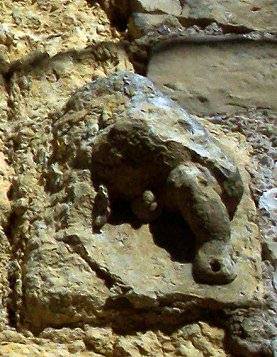
Rather later in their execution, North of the upside-down
exhibitionist corbel in the rue de l'Eglise, is a once-fine but now
very worn sandstone window of 16th century date.
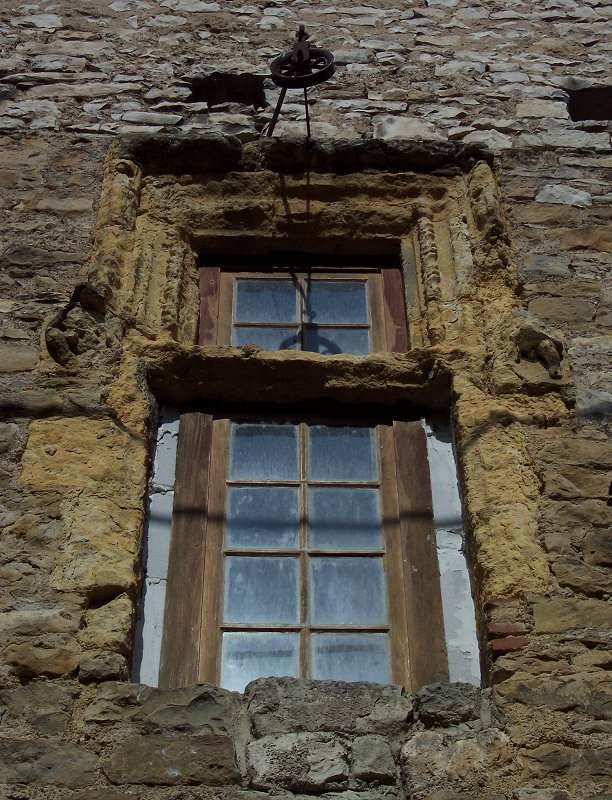
On the right and left-hand
sides, possibly taken from the Abbey like so many of Saint-Antonin's
fragments. are a bashed microphallic male exhibitionist reminiscent
of a Renaissance putto, and what seems likely to have once been
a squatting female exhibitionist. Compare these with a similar (but
earlier) pair on the island of Iona.
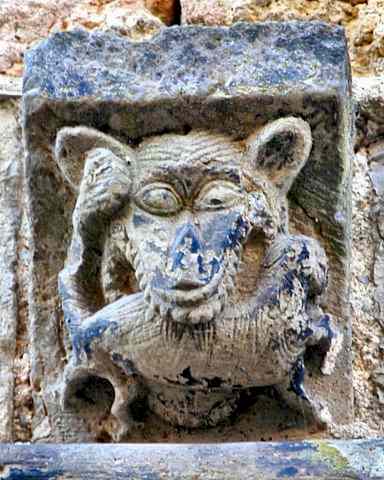
At the far end of the rue de l'Eglise is this curious little carving.
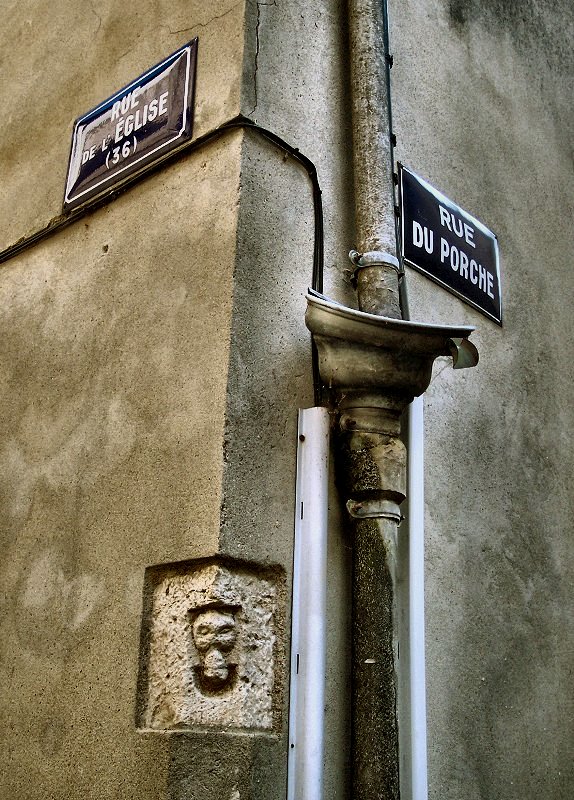
This figure overlooks the
place du Buòc.
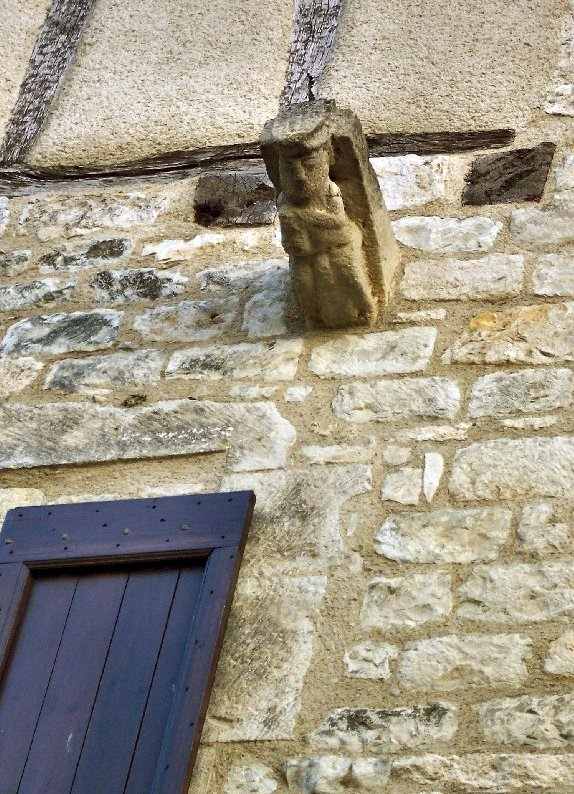
comparer with a male
exhibitionist gargoyle at nearby Bruniquel
See also the superb sculptures of the
nearby fortified hilltop town of
Cordes-sur-Ciel.
A
REMNANT OF THE ORIGINAL MEROVINGIEN ABBEY ?
click here
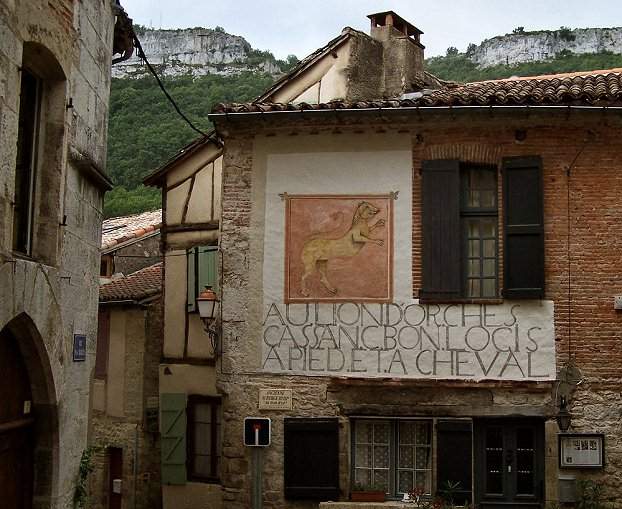
More-pedestrian information on the
little town of Saint-Antonin...
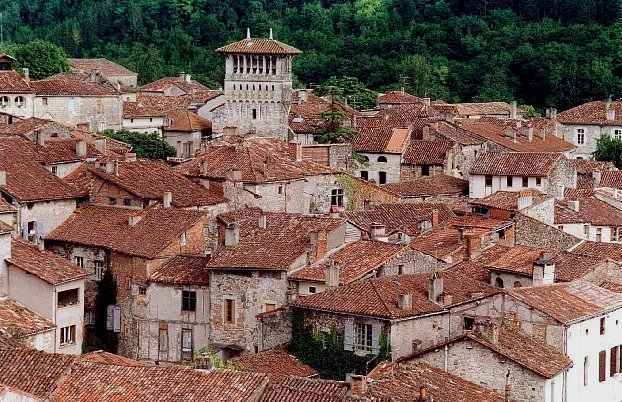
...can be found at www.saint-antonin-noble-val.com
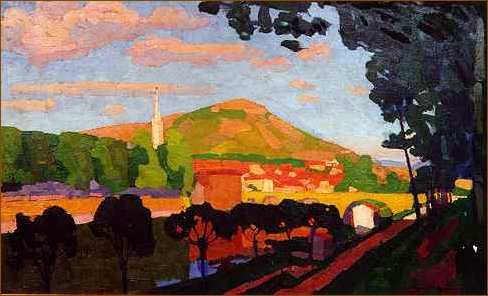
A fauve view of Saint-Antonin from across the
river Aveyron in 1905
by Montauban painter Marcel-Lenoir.
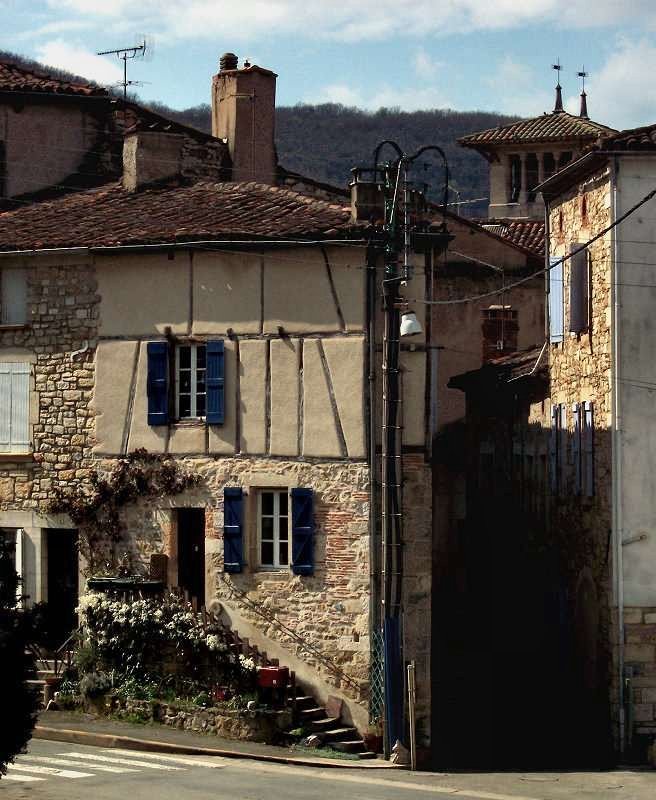
The author's former
house in Saint-Antonin is the oldest on the boulevard
(German: Bollwerk; English: bulwark)
which here, as throughout France and much of Western Europe in the 19th
century,
replaced city walls and defensive embankments.
Doors
and doorways 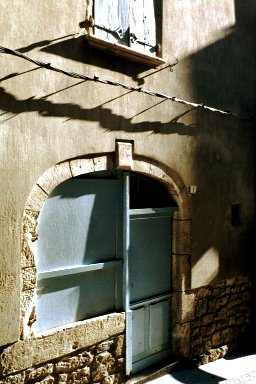 of Saint-Antonin
The most exciting thing to do at Saint-Antonin.
click the panel to see a selection of the decorated

and modified Easter Eggs of the Fourth Annual Eggfest.
Eric Faure
master-potter
Prehistoric
sites near Saint-Antonin:
Dolmens
de Saint-Antonin >
Roussayrolles
>
Saint-Cirq
>
Septfonds
>
Vaour,
Verdier
(Sainte-Cécile),
Vieux
>
Decorated
cave of la Magdaleine des Albis
>
'Le Chemin des Neuf Pierres' suggests that a stone-row
once stood in Saint-Antonin's Wagnerian amphitheatre,
overlooked by some of the tombs on the
plateaux above.
Alignments
are not unknown in Rouergue...
go to another of my websites
hunting opportunities in the area
papillons
& 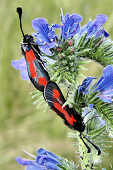 orchidees
des Gorges de l'Aveyron
The
English 'Bobs'
Saint-Antonin
was occupied by the English for about 40 of the Hundred Years
War between the (Anglo-Norman) Plantagenets and the (French) Valois
in the 14th century.
From then until the mid-19th century the English were notorious
in Europe for their violent, insolent and uncontrolled behaviour.
The Victorian period (roughly 1860 to 1960) was the exception,
when an excess of puritan "respectability" turned English
unpleasantness inward.
But
it has turned outwards again, and in the dreadful summer 'holiday'
season, even a small and charming town like Saint-Antonin can
become unpleasant at night, with English 'Bobs' (as they are
charmingly known) binge-drinking in the local cafés and
beating up anyone who attempts to quieten them, as I bloodily
and painfully discovered at the Café de la Halle, unhampered
by French restriction.
These
Yobs (as they are more-appropriately known in English) are encouraged
in the name of Tourism,
that baleful tin god of Consumption...in both senses of the
word...
In
July and August, therefore, I retreat from the heat to the pleasantly
cool, quiet and remote Irish countryside - and leave Saint-Antonin
to the profitable invasion of the beauty-snatchers...
Saint-Antonin...where
drunken English yobs once gouged FUCK in wet concrete, where
the word still surprises the unwary.
Saint-Antonin...where
it is best for inhabitants to be deaf but agile, because the
internal combustion engine is king and the old streets (all
without sidewalks) difficult to walk in; where an insane municipality
is ever buying new noisy machinery to do stupid things such
as blowing leaves off grass.
Saint-Antonin...where
potholes in the uneven streets are filled with nothing more
substantial than tarry grit, where gutters pour out water from
on high without mending or complaint.
Saint-Antonin...where
a car can be parked for a week on a pedestrian crossing, and
another for two weeks on a footpath - without an eyebrow raised.
Saint-Antonin...one
of the few towns in the whole region without a single speed-bump
on its very dangerous 'périphérique' - which in
parts has a footpath less than 60 cms wide; where cars and mopeds
zoom along ancient streets with impunity. Few cats, however,
are killed.
Saint-Antonin...where
police lie in wait - not for speeders, but for those who have
not (or not yet) attached their seat-belts (spot fine: 90 euros).
Saint-Antonin...where
even in the mediæval centre the noise levels can be intolerable
because of a noisy café at night, or kids roller-blading,
playing football - or even riding mopeds - by day in the covered
market.
Saint-Antonin...where
garish plantings are made for summer tourists, but nothing,
apart from vulgar Christmas decorations, for the local inhabitants
in winter - not even pansies.
Saint-Antonin...where
you are now not be allowed (by authorities who evidently have
never left the Hexagon of France) to paint your house or even
your shutters an interesting colour.
Saint-Antonin...where
I was not permitted to change a Velux in my canal-tiled roof
to an attractive dormer, even though Veluxes are now banned
in this conservation area.
Saint-Antonin...where
an attractive, rare old chemist's frontage was trashed, despite
being in a conservation area...where a beautiful old hotel by
the water's edge was stripped of its lovely and famous old pink
wash and made drab grey, while a modern plastic entrance replaced
the original entrance to the attractive old lobby, now 'remodelled'.
Saint-Antonin...whose
grotesque
19th century belfry on an otherwise well-proportioned
Maison des Consuls, is restored by the State (who paid
for its tasteless and expensive erection) instead of being removed.
Saint-Antonin...where
small businesses are desperately needed and are even encouraged
- but commercial rents are far too high.
Saint-Antonin...now
a fashionable place to have a second home, where t cement-mixers,
mini-dozers and all sorts of noisy machinery make a constant
clatter throughout the year as they renovate long-derelict properties
- except in the tourist months of July and August, when they
are banned. And so the wiser and/or richer second-homers buy
old farms to renovate in the hinterland, or villas closer to
town.
Saint-Antonin...which,
like most of defensively solipsistic France, lacks any kind
of decent communal spirit, yet where many locals swap gossip
on Facebook.
Saint-Antonin...where
half the dogs are free and characterful, and the other half
are kept as crypto-fascists' depressed fashion-accessories on
short leads or chains. I once saw a dog on TWO leads, one held
by a small child, but it was a French visitor, not a local.
Saint-Antonin...most
of whose inhabitants meet your eye (to the terror of the English)
and greet you every time you pass them.
Saint-Antonin...where
one of the first carburettors was invented, and one of the earliest
female photographers worked without too much contumely.
Saint-Antonin...where
beside the communal dumpsters many useful things are placed
and can be retrieved: clothing, 'white goods', kitchen equipment,
food, bedding, furniture, plants...
Saint-Antonin...which,
despite all the above, and perhaps because of its dissident
history until the end of the Wars of Religion, attracts quiet
'eccentrics', semi-hermits and reclusive artists.
|
From the Bulletin d'Informations Municipales de Saint-Antonin,
January 2007
the first and last verses of a satirical poem in Occitan doggerel, dating
from the end of the 19th century,
LA VILA DE SENT-ANTONIN
|
La vila de Sent-Antonin
Renomada per son vin
A sos quartiers e sas carrièras
Coma n'i a pas otres sus tèrra....
...E pel jardin qualqu'un disiá
Qu'i volián far un casino
E, qu'a la plaça dels cagaires
I volián metre les aigaires.
|
Saint-Antonin, that worthy town,
Produces wine of high renown,
And has streets and neighbourhoods
Like no others in the world...
...In our fine Spa's pleasure garden
They want to build a new casino.
So where the locals have a shite
The sick will gamble through the night.
|
The plan for a casino was dropped. The elegant little
Spa, built in the garden
of the ancient monastery,
did not survive the closure of the railway, and is rarely used for local
events.
The wine must have been pretty bad to have been superseded by Algerian
vin ordinaire...


see the sights
of nearby