
SATAN IN THE GROIN
exhibitionist
carvings
on
mediæval churches
DESIRE LARGE AS HELL:
emale
genital exhibitionists:
the
sheela-na-gig conundrum
HIGH-RESOLUTION PHOTOGRAPHS OF MALE AND FEMALE EXHIBITIONISTS
mouth-pullers
& tongue-protruders
ireland
& the phallic continuum
beasts and monsters of the mediæval bestiaries

field
guide
to megalithic ireland
the
earth-mother's
lamentation
Click
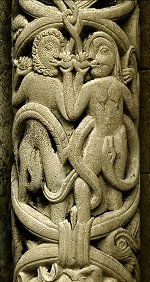
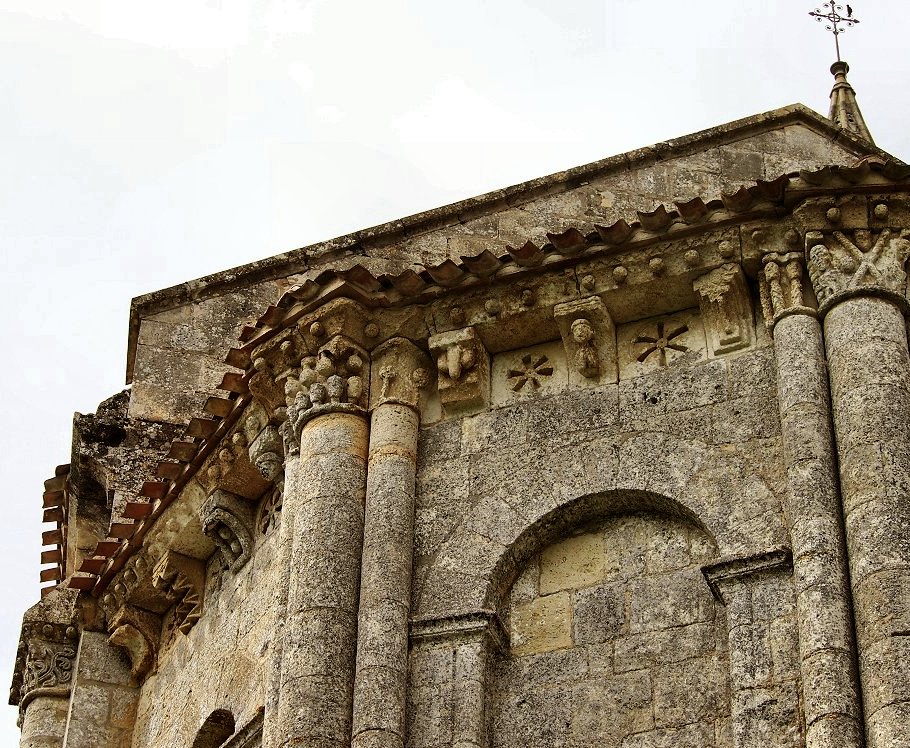
to see the carved front of a Romanesque church in Saintonge
(Western France)
Wikimedia
slide-show of corbel figures relative to this website
click the right arrow > rather than
the left
photos are of variable quality

FURTHER READING:
Jones, Malcolm
THE SECRET MIDDLE
AGES: discovering the real medieval world
Stroud,
England:
Sutton Publishing, 2002
AND
Cooke, Ian McNeil
"SAINT PRIAPUS"
an account
of phallic survivals within the Christian church and some of their pagan
origins.
Penzance,
England:
Men-an-Tol
Studio, 2002
(available only from the author)
PLUS
MARGINAL SCULPTURE
IN MEDIEVAL FRANCE:
towards the deciphering of an enigmatic pictorial language
Aldershot,
Hants., England:
Scolar Press.
Brookfield, Vermont, USA: Ashgate Publishing Co.
1995
ISBN 1-85928-109-5
It
may be ordered
at a discount through:

and outside
the British Isles through amazon.com
This book, however, regards subjects such as exhibitionists and mouth-pullers as marginal - which, being on several doorways and interior capitals, they surely are not.
Part of the scanned text is included in the
Bosch detail
|
male figures: part III
|
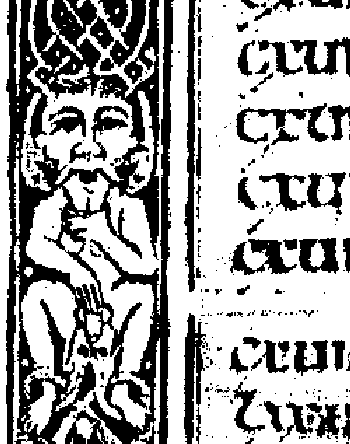
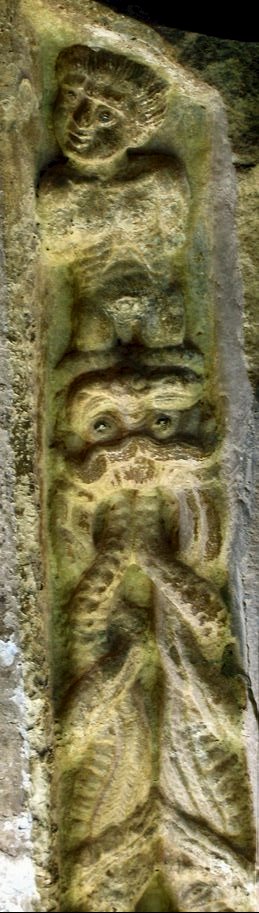
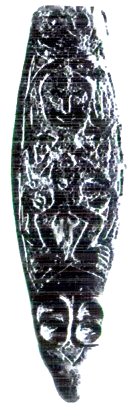
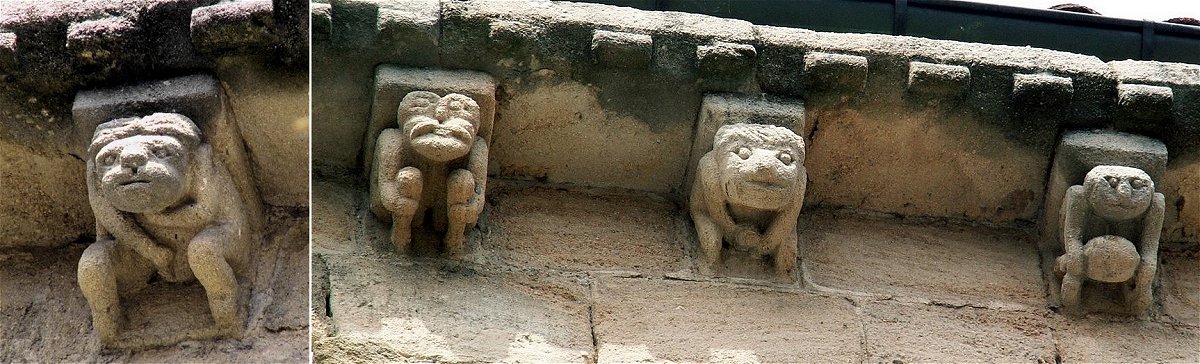
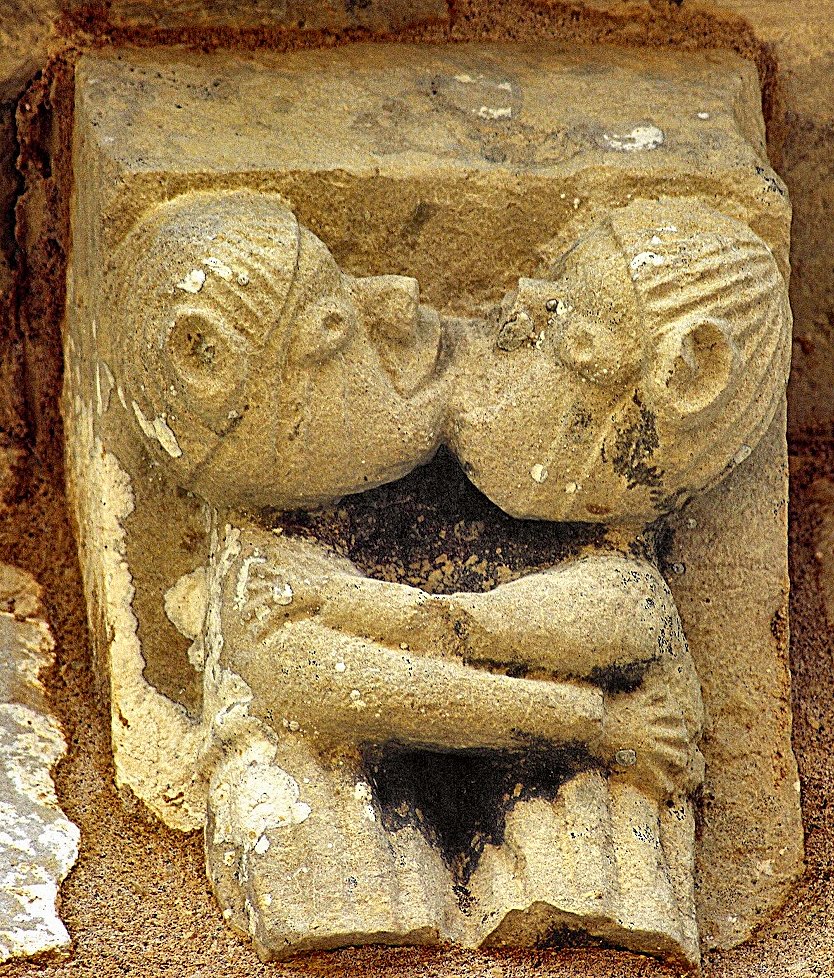
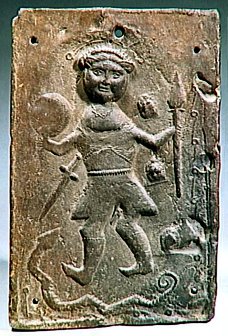
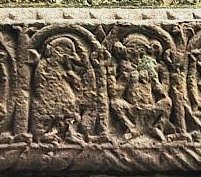
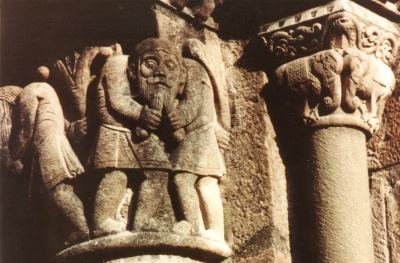
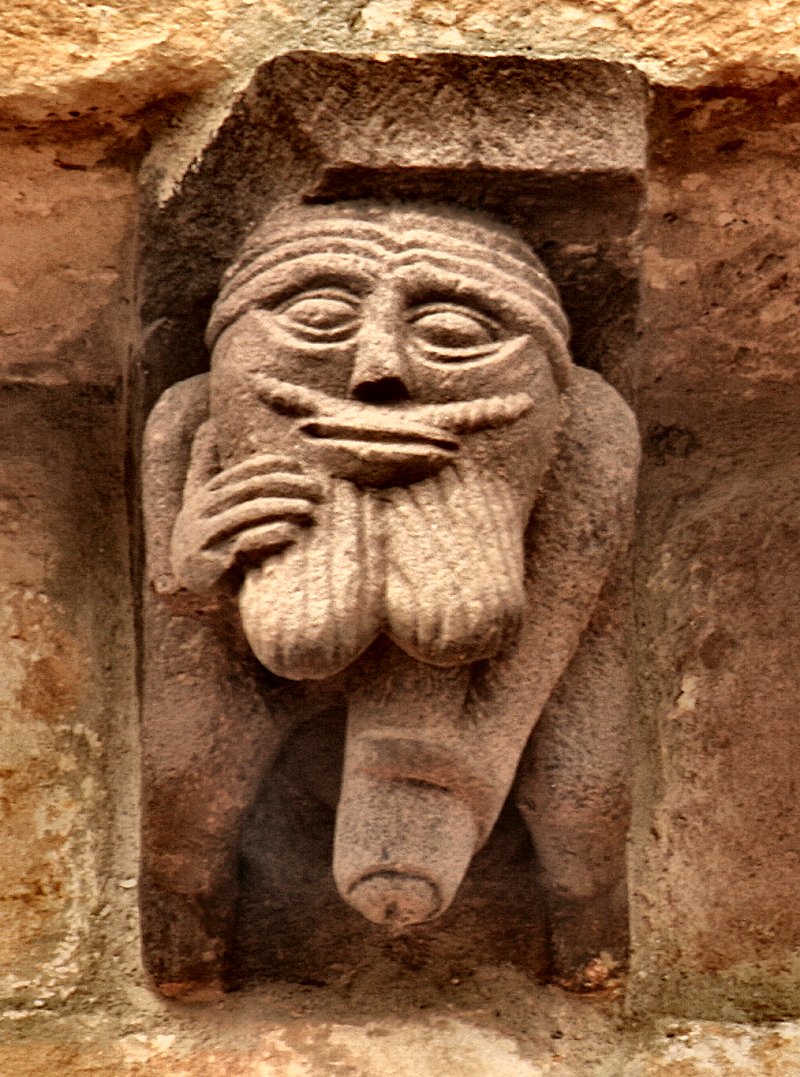
Elines (Santander), Spain
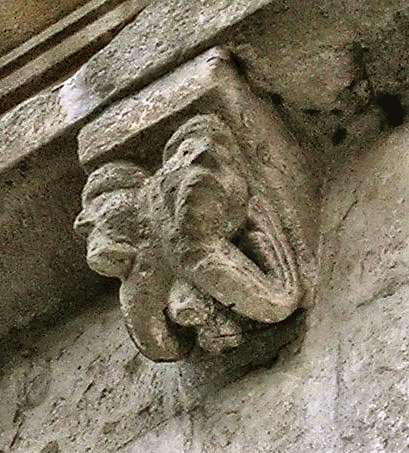
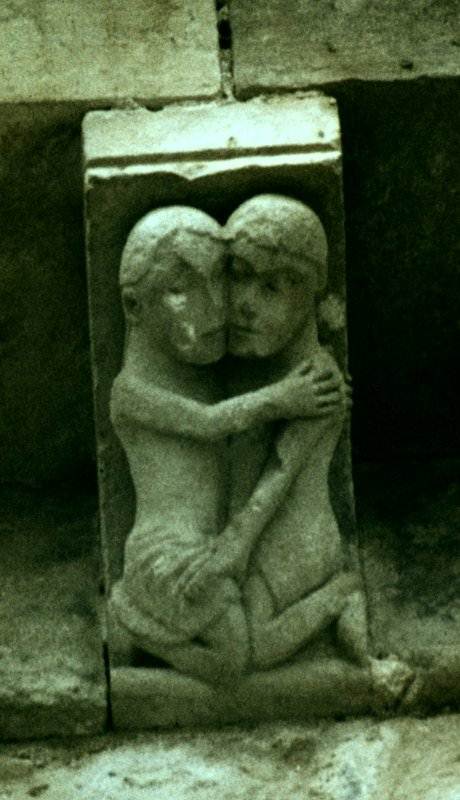
A remarkable variation
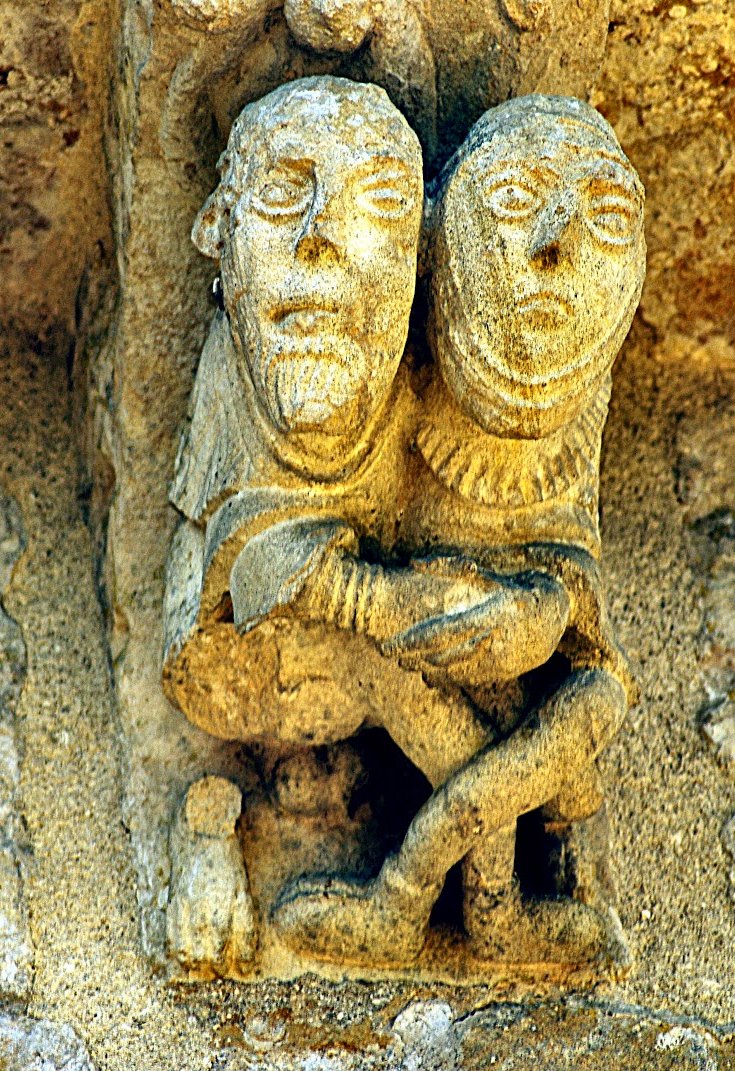
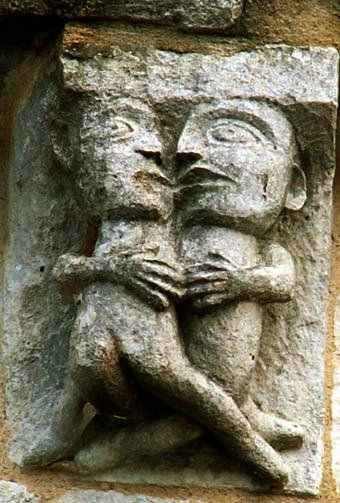
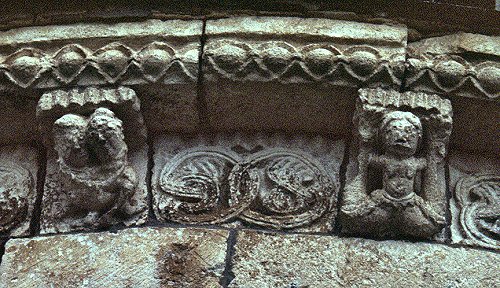
on bicorporeality can be seen on a corbel at Saint-Médard-de-Guizières
(Gironde)
where two adossed men share a single penis.
|
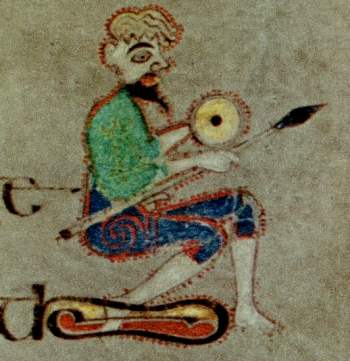
Slightly earlier than the Anglo-Saxon manuscript, the Irish Book of Kells shows a warrior with spear displaying his virility - but as a vignette, without any evident censure. |
 another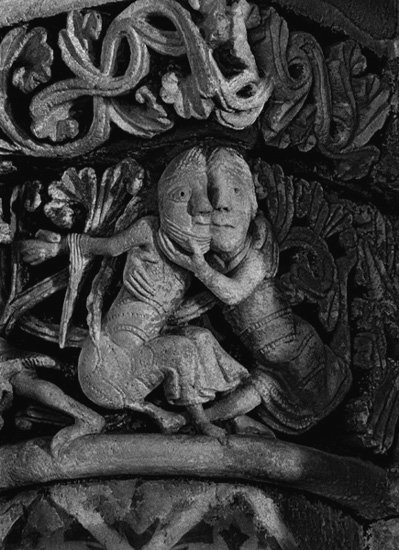
Faithfulness.jpg)
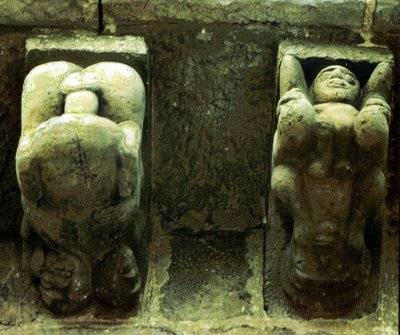
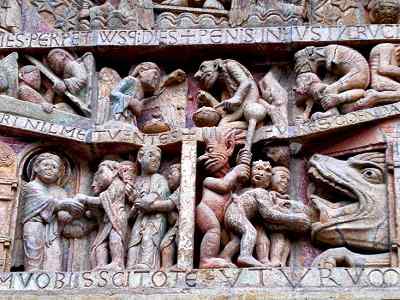
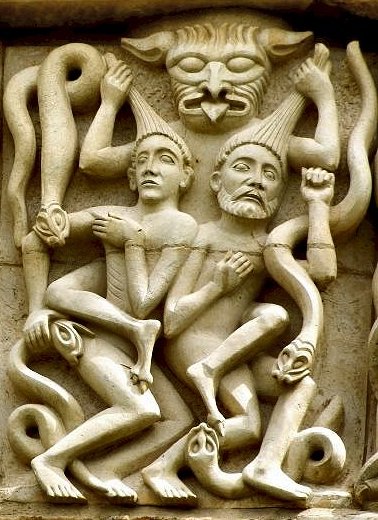
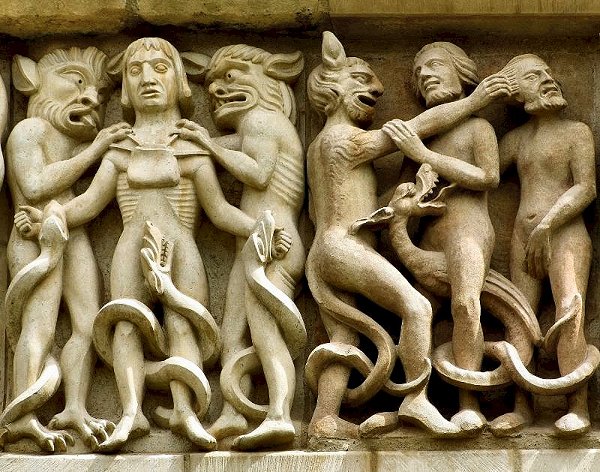
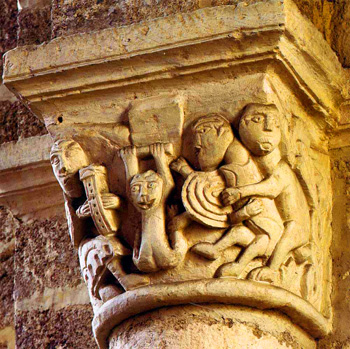
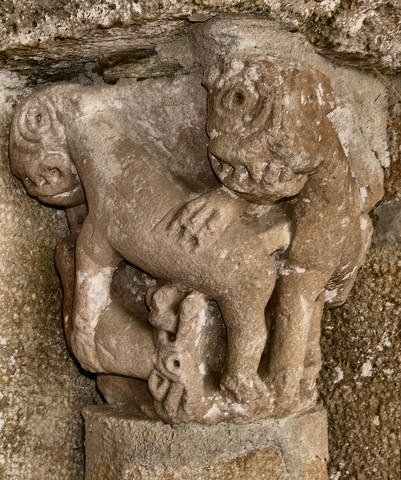
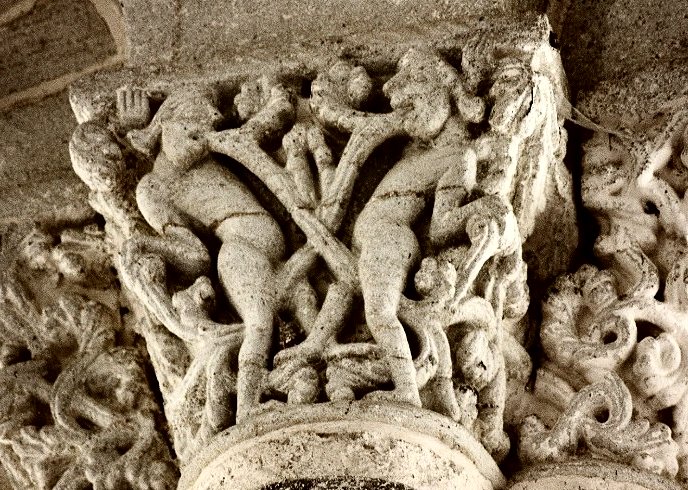
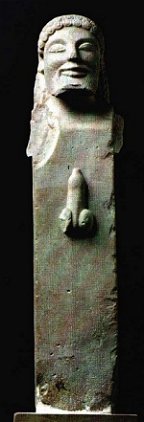
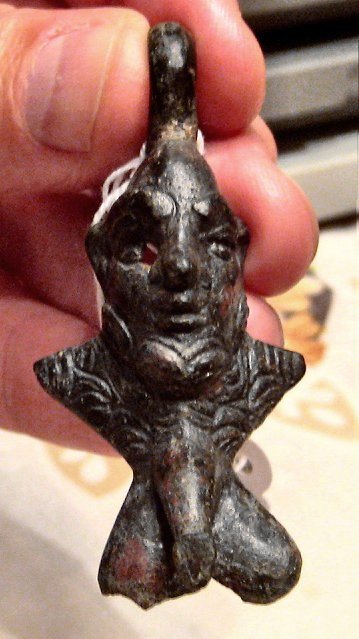
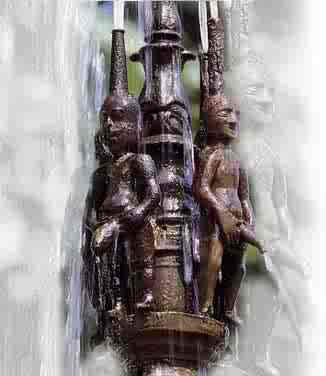
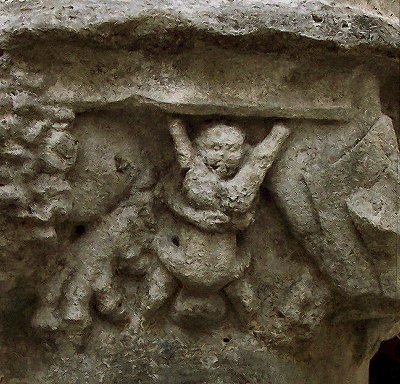



|
verse 11: For the stone shall cry out of the wall, and the beam out of the timber shall answer it. verse 11: Woe to him that buildeth a town with blood, and stablisheth a city by iniquity. verse 15: Woe unto him that giveth his neighbour drink, that puttest thy bottle to him, and makest him drunken also, that thou mayest look on their nakedness. verse 16: Thou art filled with shame for glory, drink thou also, and let thy foreskin be uncovered: the cup of the Lord's right hand shall be turned unto thee, and shameful spewing shall be on thy glory... verse 18: What profiteth the graven image that the maker thereof hath graven it; the molten image, and the teacher of lies, that the maker of his work trusteth therein, to make dumb idols ? verse 19: Woe unto him that saith to the wood, Awake; to the dumb stone, Arise, it shall teach...
|
Serious and justified worries about the loose morals of the
rich account for the scenes of lasciviousness and concupiscence
amongst other sins on capitals and tympana. Modern minds, however,
find it difficult to understand why the highly-exaggerated corbel-carvings
were put up on churches - pieces of sculpture sometimes far
more graphic than was doctrinally necessary. A likely
explanation,
less fanciful than it might seem at first, and able to account
for both the Romanesque and most post-Romanesque corbel-figures,
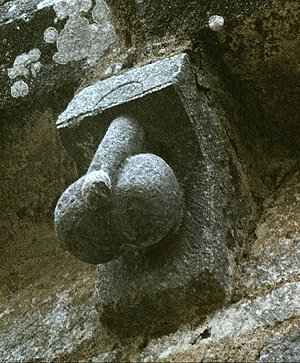
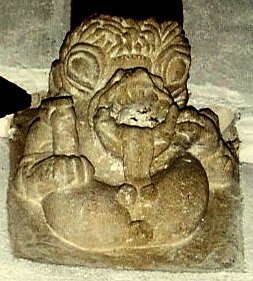
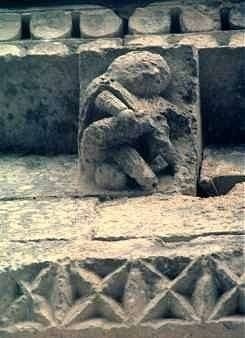
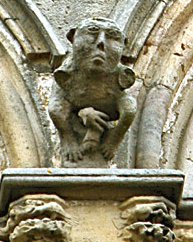
is an anthropological one. The carving of an exhibitionist (male
or female) or any daring or dodgy motif on a corbel-table might
well have been the culmination of the apprenticeship of a sculptor,
literally a licence granted to him by his fellow-sculptors who
certainly were the inspiration of the Freemasons in their confraternity.
Masons' marks occur on churches all over Europe, and especially
in Spain where monks and clerics trailed in the wake of the
bloody Christian war-lord land-grab sanitised under the name
Reconquistà, and built churches with the guilt-money
given them by knightly versions of Milosević and Karadzić
- and Franco.
Even today, masons and sculptors form exclusive teams and (like many co-operative tradesmen who feel undervalued) perform scabrous rites. In Romanesque times, to be a sculptor was as prestigious as being an international architect today. It is possible that sculptors were more powerful than priests on the ground, because they could simply take off from a site and find employment elsewhere without difficulty. So the carving at Girona (below) might have a different meaning than that which I advanced earlier in Images of Lust. The bishop may well not be overseeing the sculptors like some kind of art commissar, but merely skulking. The sculptors or masons take prominence in the scene, which might be telling us not that nothing went up on a church without ecclesiastical approval, but that what was sculpted went up on a church despite ecclesiastical qualms.
So, in this theory, sculptors who met with the artistic approval of their fellows, had the privilege of carving one or more startling corbel - a kind of satire on the exhibition-piece which is required of skilled craftsmen in wood and stone even today, which then was either slipped past ecclesiastical approval or was placed defiantly or by right and rite. Some (very few) might have had to be placed very high or out of sight to avoid local trouble. But it is pertinent to this theory that many churches in Spain were not properly finished: unfilled scaffolding-holes abound, so teams of masons could up and off with an impunity very similar to the propensity for strike action enjoyed by trades unionists in post-War France and Britain.
The drawback of the theory of initiation-, prentice- or master-pieces of sculptors fully received into their teams, guilds or confraternities is that a few of the Romanesque males are extremely crude efforts. These exceptions might well be simple imitations on churches whose sculptors were not master-craftsmen..
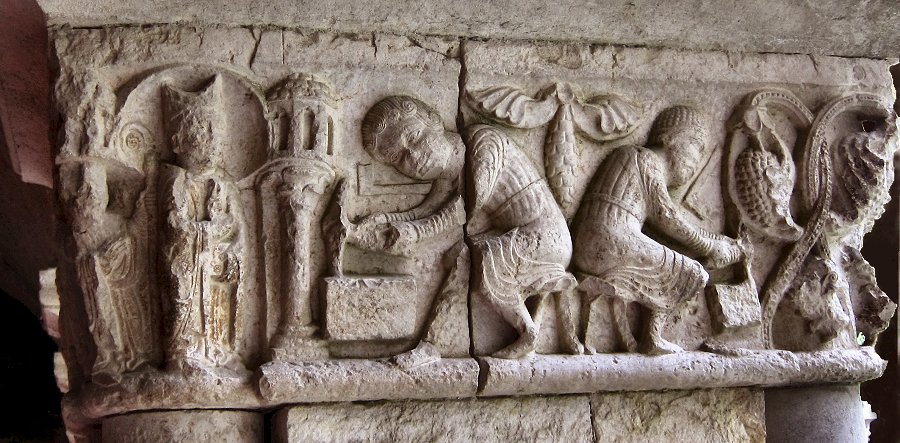
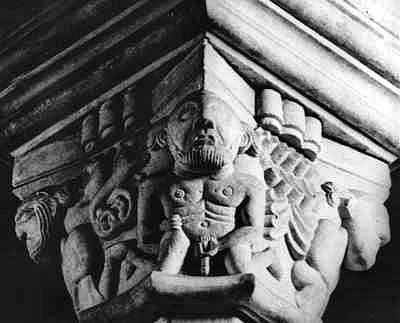
Cloister capital, Girona (Spain) click to enlarge
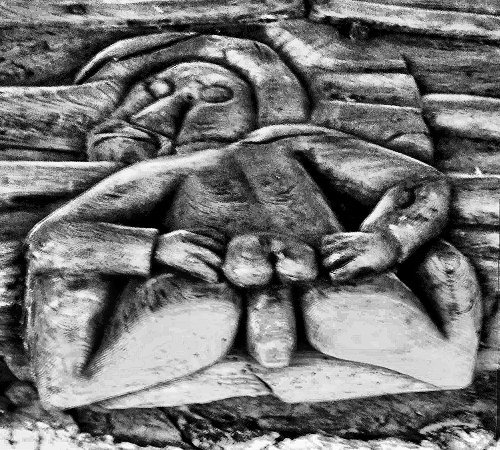
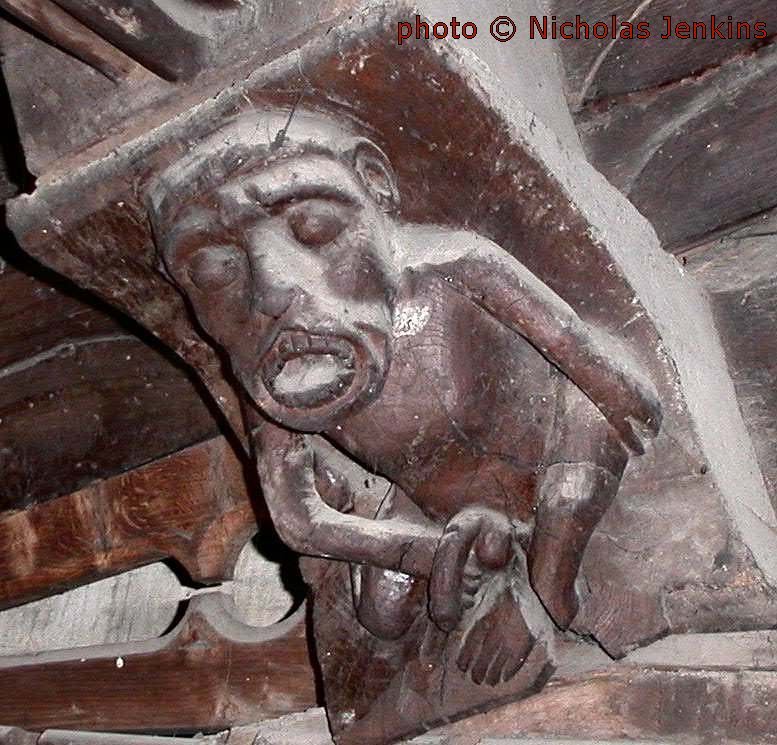
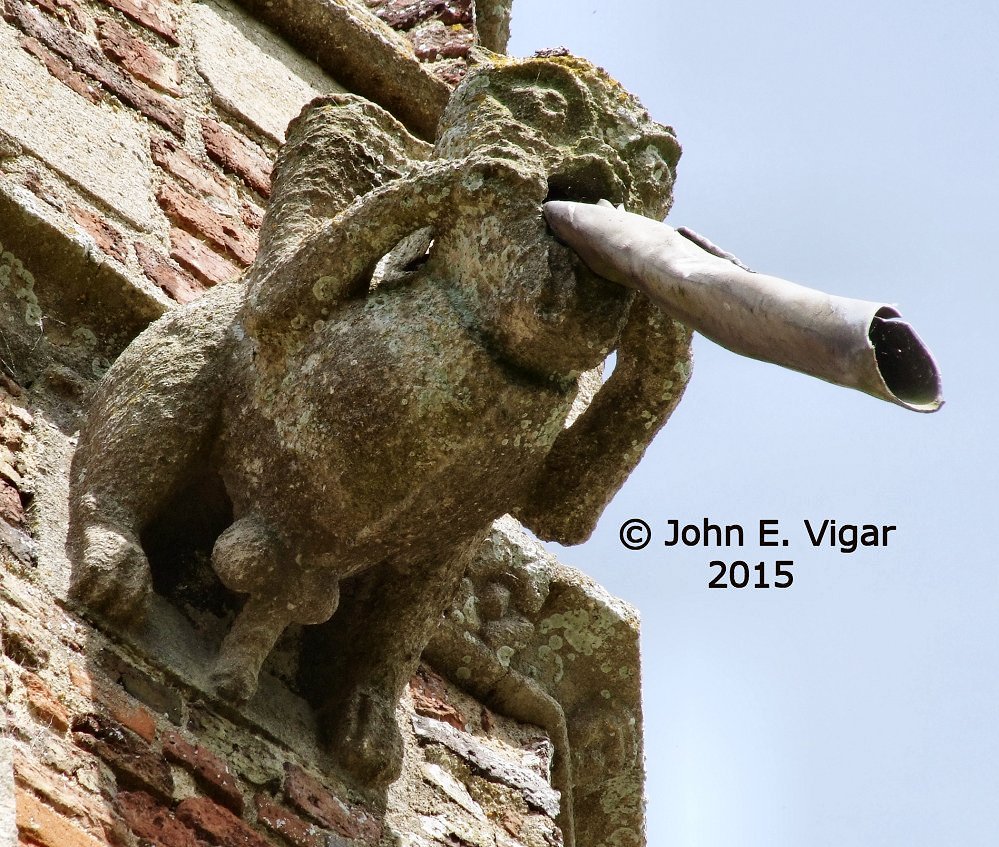
However, some extremely well-carved male exhibitionist gargoyles and other figures can now be seen high up on church towers, out of sight except to the keenest eyes (which were not so common in mediæval times) - for example Ewerby (Lincolnshire) and Wiggenhall (Norfolk) - and even on secular buildings, as at Bruniquel (all mentioned above). The beam-carving at Claybrooke Parva is tucked away high above the western end of the nave and is quite small to the unaided eye. Without modern binoculars and a powerful torch it would be easy to overlook. This may suggest a magical-apotropaic function for post-Romanesque figures, as with the post-Romanesque females.
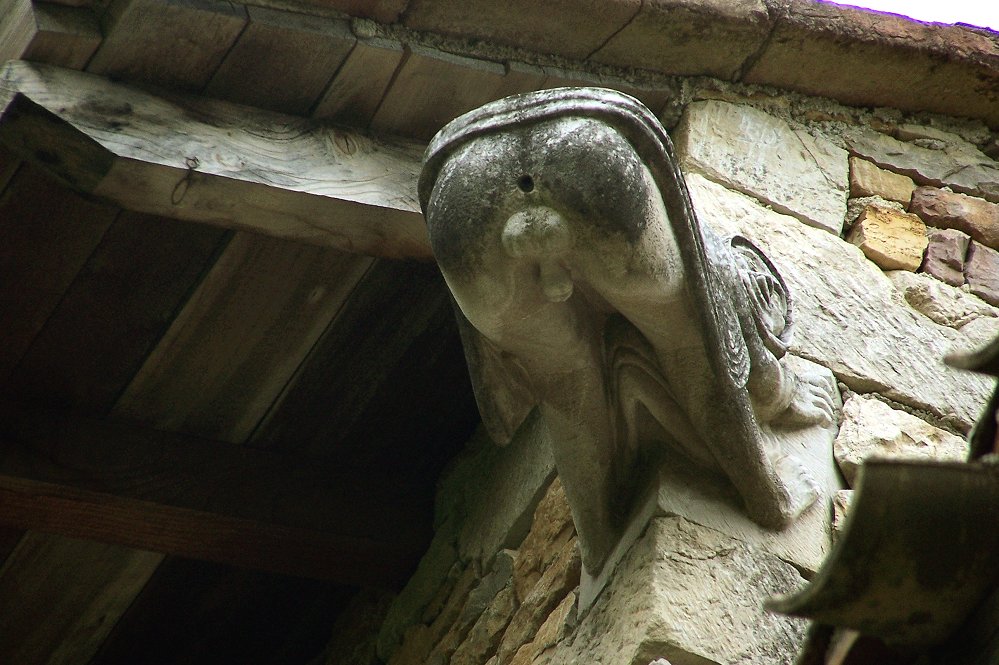
But generally speaking, male exhibitionists are not magical. Nor are they simply ancient survivals from an imagined, invented "Celtic" or Classical-pagan past, but sculptures which fitted into their Christian context by dint of - on the one hand - widespread and uncontrollable concupiscence amongst the peasantry and to an extent amongs the lowliest clergy who were drawn from that peasantry. On the other hand, they might very well have been not only exhibitionists but exhibition pieces, proudly and lewdly displayed by master-craftsmen as quasi-pious jeux d'esprit.
Phallic and male-exhibitionist images, just like their female counterparts are surely intended to be attractive/protective or repulsive - depending on the attitude of the viewer.
Finally, it would be instructive to note the similarities between the 14th century Libro de Buen Amor (Book of Good Love/Loving) by Juán Ruiz and the iconography of Romanesque churches, particularly corbel-tables. Both mix the 'sacred' with the 'profane' - a very variable and sometimes ambiguous dichotomy. Both are sometimes scatological. Both display irony and humour. And both are frequently enigmatic, ambivalent. While two centuries separate the Libro and the execution of the explicitly sexual Romanesque corbels and capitals, mediæval life was very similar for those living in Spain and Catholic (non-Cathar) France and beyond during those times, when the rôle of the Catholic church was pervasive.
Similarly, and closer to the 12th century is Carmina Burana,
which, according to Wikipedia, is "a manuscript of 254
poems and dramatic texts mostly from the 11th or 12th century,
although some are from the 13th century. The pieces are mostly
bawdy, irreverent, and satirical. They were written principally
in Mediæval Latin; a few in Middle High German, and some
with traces of Old French or Provençal. Some are macaronic,
a mixture of Latin and German or French vernacular, written
by students and clergy when the Latin idiom was the lingua
franca across Italy and western Europe for travelling scholars,
universities and theologians. Most of the poems and songs appear
to be the work of Goliards: minor clergy (mostly students) who
satirised the Catholic Church. The collection preserves the
works of a number of poets, including Peter of Blois, Walter
of Châtillon, and an anonymous poet..."
In the same spirit of joie-de-vivre - in opposition to the Christian
use of the exhibitionist motif - is a remarkable pair of gateposts
in county Donegal in north-west Ireland. These are covered by
cement rendering, into which were incised - when wet, sometime
near the end of the twentieth century - a male and a female
exhibitionist figure facing each other.
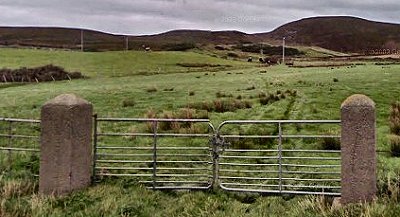
click to read about this syncretic piece of 'folk-art'
non-copyright Anthony Weir, 2007-2026
  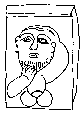  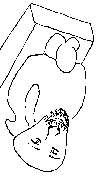 |
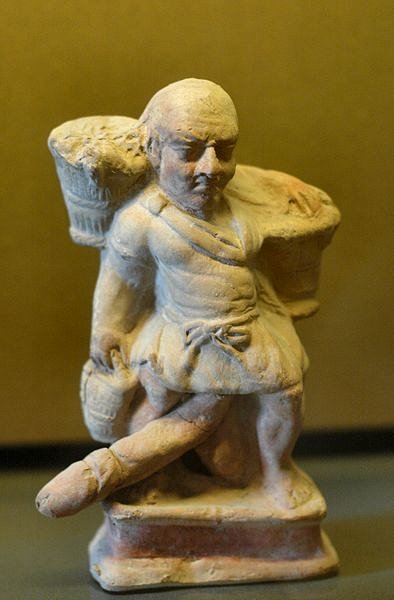
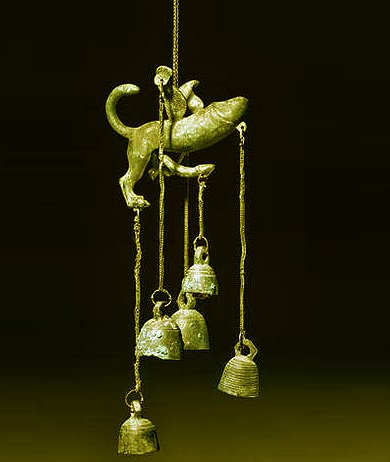
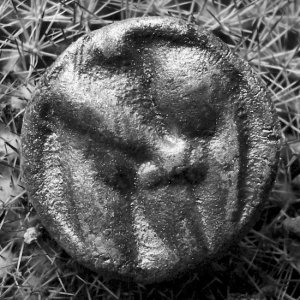
An antique (probably Roman) brothel-token.
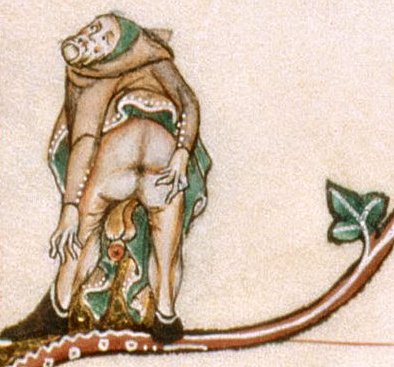
Late 14th century anal exhibitionist from the Gorleston
Psalter.
This is a direct (if anatomically incorrect) lampoon on sexual
practices in monasteries.
The brown habit is worn by the Franciscan Order of Friars Minor
and Friars Minor Capuchin.
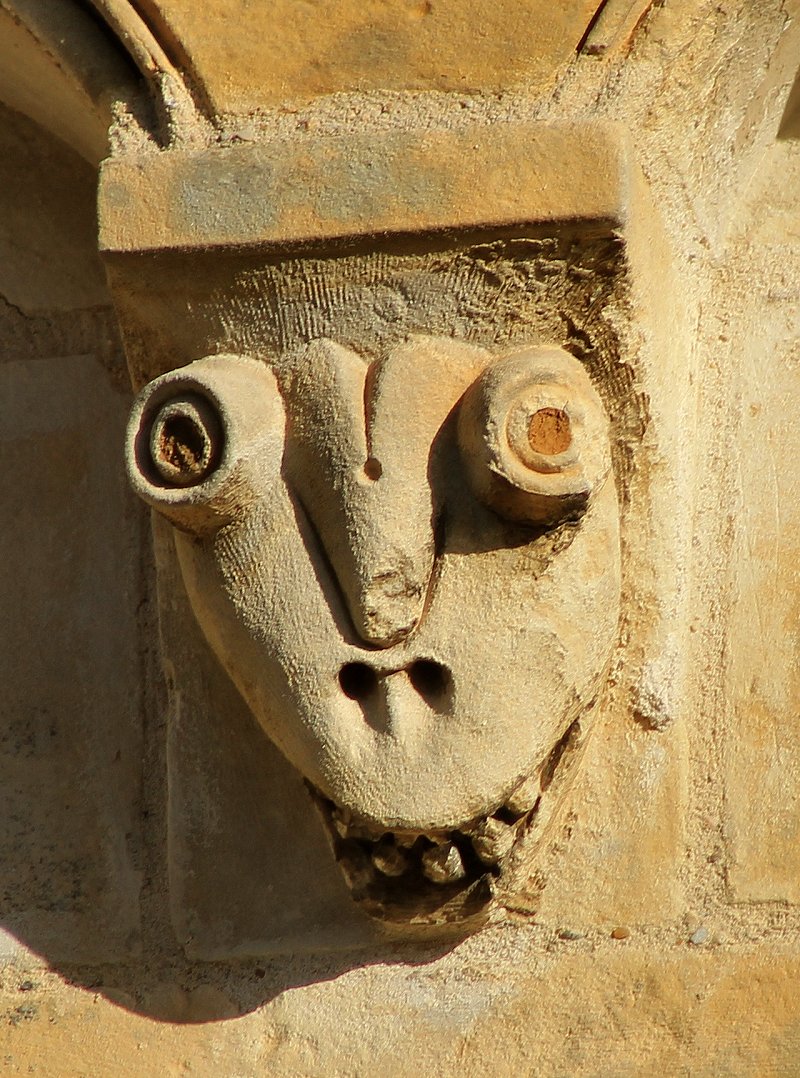
A beast-head/genital joke ?
A corbel at Carpiquet
(Calvados), amongst many, all of them jeux d'esprits,
none of them exhibitionist, a characteristic of very late corbels.
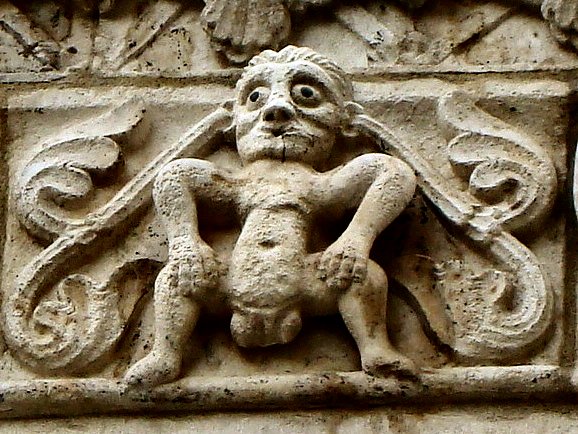
Male, female or hermaphrodite ?
Part of a frieze on Nîmes cathedral (Gard).
But not all naked figures are sinners.
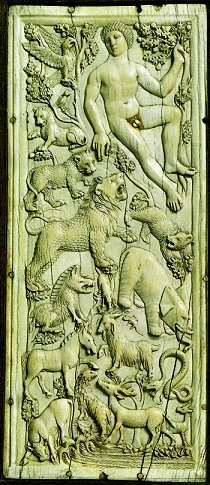 |
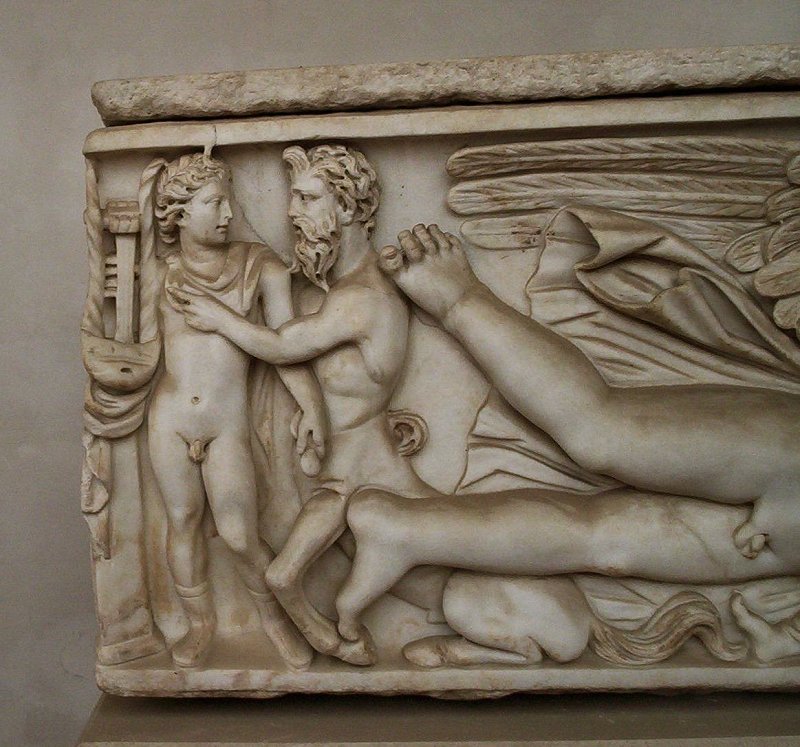
Adam (?) Lord of Beasts (in Eden ?) on a 5th century ivory in the Bargello Museum, Florence. |
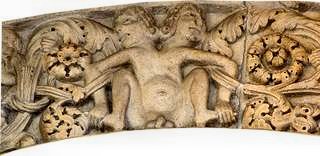
This detail of the archivolt of the South front of Modena
cathedral
seems not to represent concupiscence or sexual desire.
ESSENTIAL READING

Reaktion
Books, 1992.
FURTHER READING
Sodomy,
Masculinity and Law in Medieval Literature: France and England,
1050-1230
(Cambridge Studies in Medieval Literature)
by William E. Burgwinkle, 2009.
The Introduction
and Conclusion can be read online.
Here are a few lines from the Conclusion.
"St
Anselm defended his reluctance to prosecute sodomy in 1102 with
the argument that it was already so commonly practised that
people would have difficulty recognising it or themselves within
the category. Such a statement could not have been made by the
end of the century, when 'sodomy' had become a matter
of discourse and persecution. In the intervening years, increased
attention to celibacy, monastic rules, marriage practices, and
the status of knighthood had the effect of calling attention
to the performative nature of masculinity, to its ritualisation
and theatricalisation. Institutions responded by setting up
ever more rigorous criteria by which men earned, or failed to
earn, their masculine status; and accusations of sodomy began
to feature in these attempts to discipline masculine subjects
by controlling and patrolling gender barriers."
List
and distribution-map of
exhibitionists in Western Europe
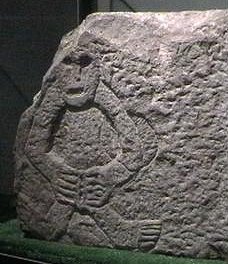
| The Enigma of the 'Sheela-na-gigs' |
 |
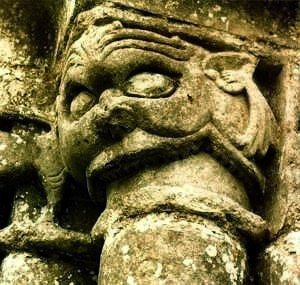
The MYSTERIES of the COLUMN-SWALLOWERS >
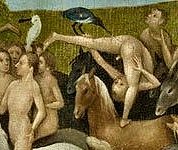
Bosch: detail from
The Garden of Earthly Delights,
circa 1500
The pictures and text on these pages are condensed from a former Work
in Progress, The Silent Orgy.
They are dedicated
to the late Martha Weir,
who was amazed but unfazed by these carvings,
and without whom Images
of Lust"
would never have been researched or written.

Some Relevant Spanish Websites :
Las representaciones obscenas en el arte románico: entre la vulgaridad
y la apostura
https://www.academia.edu/37246446/
El enigma del Románico Erótico
https://www.arteguias.com/arteerotico.htm
Erotismo en el arte románico y medieval
https://educomunicacion.es/arte_erotico/romanico_medieval_arte_erotico.htm
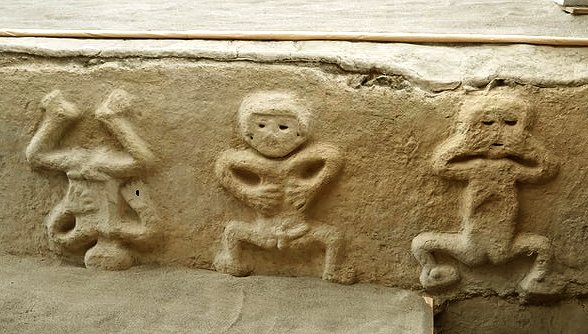
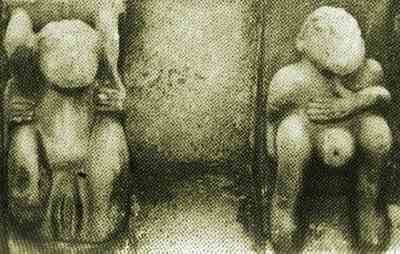
The figures above have nothing to
do with exhibitionist sculptures in Europe:
they are Caral images of famine from Peru.
|
Click
here for a related essay: |
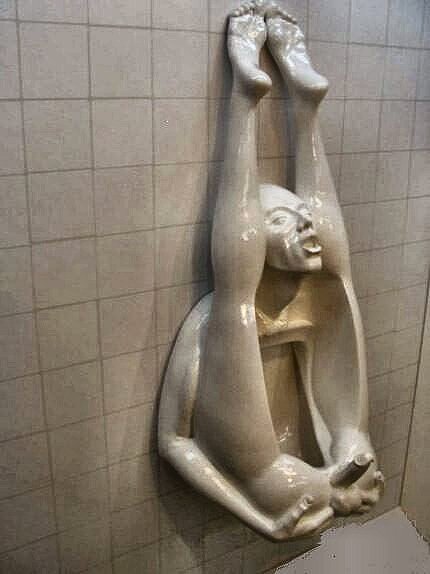
A
very modern interpretation
of the Male Exhibitionist Motif >
|
He
says it is a stonemasons' tradition to do so and said that anyone
looking for it would have to look carefully to find it. Cathedral
spokesman Glyn Morgan said they were not too surprised as they
were aware of the craftsman's tradition of leaving little jokey
reminders.
June 2007 http://news.bbc.co.uk/1/hi/england/hereford/worcs/6249344.stm
|
Within the context
of images of lechery, this report should be treated with caution -
but
we should also not overlook the possiblity of the unintended consequences
of putting up funny little obscene carvings on churches.
What might have appalled prudish monks might well have amused illiterate
peasants, pilgrims and passers-by.

I am especially grateful to Tina
Negus, Julianna Lees, Jacques
Martin, Kjartan Hauglid, Bob Trubshaw, Jean-Marie
Sicard and John Harding
for their generous help and donation of photos to this website.
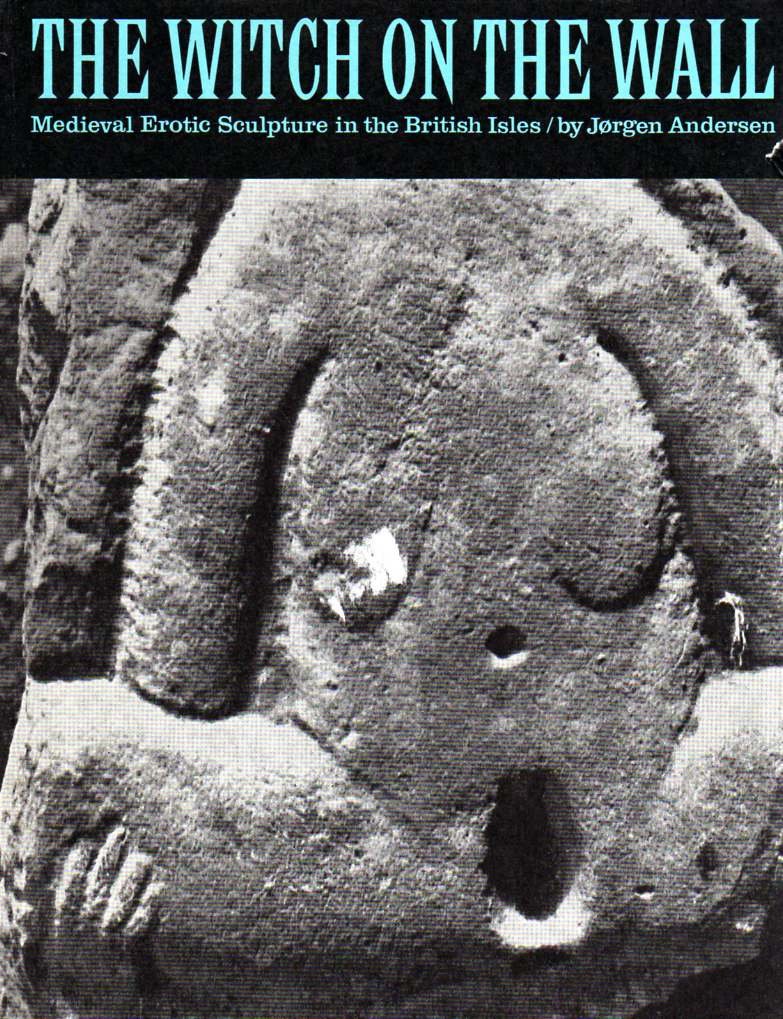
I am also indebted to the late, ebullient Jørgen
Andersen, who directed my researches
and me (and my mother) towards France in 1975.
SEARCH THIS SITE USING
This site has been enhanced by FloatBox